Free Shipping across India
What can we help you find?

In a shop you would judge a macrame wall hanging by touch. Online, three things do that job: the width of the piece, the fibre it is knotted from, and how dense the knotting is. Those three decide whether it reads as a small accent or a full feature, and they explain why this collection runs from Rs 849 to Rs 7,499. This guide covers materials, knots, hanging hardware, and care in Indian conditions, so you can choose between sizes with confidence.
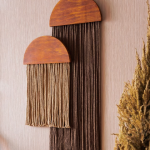
Nearly every design here is knotted in natural cotton rope, and many are built on rattan. The product names describe the construction plainly: the Semi Circle Rattan hangings are knotted onto a curved cane frame, the Hexagon Mesh piece is an open lattice, and the fibre-art designs such as the Oval Line and Mid Century hangings combine flat weaving with knotwork. Cotton gives a soft, matte surface, most often in natural off-white. Rattan gives the piece a stiff outline, which matters at larger sizes, where a frameless hanging can slowly lose its shape.
Study the product photos before comparing prices. Tightly packed square knots produce a ribbed surface that throws small shadows and reads clearly from across the room. Open knotting, as in the mesh designs, lets the wall colour show through and feels lighter. Long fringe at the base adds drop without adding much weight. Knot density is also the reason macrame sits in our wall sculptures range rather than beside framed prints: the surface has genuine depth, and side light from a window or a warm lamp makes that depth visible.
Measure the wall before you shortlist. Above a queen bed, which is about 60 inches wide, a hanging 24 to 36 inches across looks proportionate, with its top edge 8 to 12 inches above the headboard. A narrow passage wall or the strip beside a wardrobe suits a 12 to 18 inch ring piece. Behind a sofa, either go wide with a single piece over 3 feet, or hang two or three smaller rings at staggered heights. Remember the fringe: 2 feet of knotwork can drop closer to 3.5 feet once the tails are counted.
Most of these designs hang from a rattan ring or a top bar, so you need one strong point on the wall. Cotton pieces are light, usually well under two kilos, and on the brick and concrete walls common in Indian flats a single nail driven at a slight upward angle holds them for years. For larger framed pieces, use a plastic wall plug and screw. On POP or plasterboard false walls, use an anchor or an adhesive hook rated above two kilos. A wide bar-hung piece sits flatter on two hooks under the bar ends. One caution: hang from the ring or bar, never from the knotting, because a nail through the cords pulls the pattern out of line.
The wall above the headboard is the classic spot, partly because macrame carries no glass and weighs little, so it is safe over a sleeping person in a way a heavy frame is not. In the living room, a large round or semi-circle piece above the sofa gives the seating wall a clear centre without fighting the TV opposite. Covered balcony nooks work too, beside a cane chair or over a plant shelf, as long as rain cannot reach the fibre. Skip bathrooms and kitchen walls; steam and cooking grease settle into cotton and will not come out easily.
Dust is the main enemy in most Indian cities. Once a month, shake the piece out on the balcony and go over it with a vacuum brush attachment or a hairdryer on the cool setting. Keep off-white cotton away from direct afternoon sun; a west-facing wall that gets hard light will yellow the fibre within a couple of years. During the monsoon, check that the wall behind it stays dry; cotton pressed against damp plaster can pick up mildew spots. If a mark appears, dab it with a cloth wrung out in mild soap water, then dry the piece flat in shade. Never soak a knotted hanging; wet cotton stretches and the pattern sags.
The collection runs from Rs 849 to Rs 7,499, and the spread mostly tracks size and knot work. Compact single-ring hangings sit at the lower end, which makes them an easy first purchase or a pair for a narrow wall. The upper end covers the wide, densely knotted designs, including layered and multi-colour pieces meant to carry a wall on their own. If you are torn between two sizes at similar prices, take the denser one; on the wall, depth of texture registers more than a few extra inches of width.
Macrame mixes well with other natural textures. Cane, terracotta, and unpolished wood sit comfortably beside knotted cotton, and our boho wall art collection is built around exactly that palette. It also works as the single soft element on a framed wall: one hanging among prints breaks up the glass. If you are planning a full gallery wall, browse the wider wall art range first and leave one clear spot for the knotted piece, since texture needs a little breathing room to be read.
First, confirm your wall material; it decides the hardware: a nail for brick, an anchor for POP. Second, photograph the empty wall and hold the phone at arm's length; if bare space dominates the frame, size up. A macrame piece that is slightly too large almost always looks better than one that is clearly too small.